
Konzepte
- Statement des Künstlers
- Projektbescheibung
- architektonisch- statische Konzeption
- Lichtkonzept
- Veranstaltungen
Modelle, Pläne
- Modellfotos
- Baupläne
Ort, Zeit
- Ortsbeschreibung
- Ablaufplan aktuell
Personen
- Henry Puchert
- Arbeitsgruppe
- Autoren vor Ort
Hütte + Hütte = Skulptur
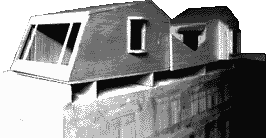
Dresden 2007: Hinaufsteigen, Eintreten, in die Höfe blicken, Verweilen. Von zwei Hochständen schaut man aus zwölf Metern hinab in das Getümmel der Dresdner Neustadt, dem man eben noch selbst angehörte. Rio, Rio heißt die begehbare Skulptur aus zwei Baukörpern, die als Kunstprojekt im öffentlichen Raum zwischen Mai und Oktober 2007 entstehen wird.
Der Dresdner Künstler Henry Puchert montiert die beiden Pavillons - etwa acht Meter lang und knapp vier Meter hoch - auf das Wohnhaus Böhmische Straße 27. Der Besucher steigt über einen freistehenden Treppenturm auf das Flachdach des dreistöckigen Hauses. Er gelangt auf ein Plateau, worüber er die beiden Hütten erreicht.
Es soll ein Ort sein, der Aspekte von Behausung ins Gedächtnis ruft. Werden diese auf einer Skala abgetragen, dann beginnt sie bei stetiger Sesshaftigkeit und endet irgendwo in Formen des modernen Nomadentums. Das Kunstprojekt - das spanische Rio heißt Fluss - transportiert im übertragenen Sinn Gedanken, so wie große Ströme Verkehrsadern und Handelswege sind. In der zeitlichen Begrenztheit des Vorhabens wird das Provisorische und Vorübergehende deutlich, das diese Kategorien von Gebäuden in sich tragen.
Die äußerlich Steilwandzelten ähnelnden Kuben werden aus Restmaterialien zusammengefügt, die vor dem Schredder gerettet wurden. Das sind weggeworfene Sperrholz- und Spanplatten, die als wertvolle Ressourcen ein zweites Mal verwendete werden. Die komplementären Farbtöne beider Baukörper betonen das Prinzip der Einheit in der Polarität: Hütte + Hütte = Skulptur.
Dennoch sind die Dach-Pavillons nicht losgelöst aus dem Innenleben der Dresdner Neustadt. Auf wenigen verlassenen Hinterhöfe und brach liegenden Versteckplätzen des Viertels sind Enklaven des Provisorischen noch zu finden: Baracken, Bauwohnwagen oder Schuppen. Die beiden Hütten unterliegen keiner speziellen Funktion, sondern sie experimentieren mit Raum, Form, Licht, Material und Proportionen.
nach oben
Die Skulptur ist der künstlerische Ausdruck dafür, dass in der Neuzeit unser Bedürfnis, die Landschaft oder den urbanen Raum zu besetzen und zu erobern, überlagert worden ist von dem starken Wunsch, uns selbst kritisch in unserem Umfeld zu betrachten. Im Unterschied zu den großen Gebäuden fügen sich die Schutzhütten, Aussichtspunkte und Refugien unauffällig in Landschaften.
Häufig tun sie das auch, um ihre Umgebung zu betonen, sodass diese mehr als das kleine Bauwerk selbst zum Mittelpunkt des architektonischen Entwurfs werden. Der Gegensatz von massivem und funktional klar bestimmtem Wohngebäude und den zwischen Kunst und Architektur changierenden kleinen Bauten wird kaum sinnfälliger als in dem Gründerzeithaus, das die beiden Zeltpavillons Huckepack trägt.
Hütten spiegeln im sozialen Kontext primär Zuwanderung und Armut. Sie sind in den Megastädten anzutreffen, wo sie auf engstem Raum eine Überzahl von Menschen beherbergen. Sie kommen von außen und setzen sich fest. Den Baukörpern wohnt diese Symbolhaftigkeit der Hütte, des Zeltes und des Lagers inne. Sich dieser Idee auszusetzen, die sich über der Stadt - gleich einer Fatamorgana - ausweitet, das will Rio Rio. Das Steinhaus wird zum Postament, sein Dach zur Tribüne, und der öffentliche Raum zum vorübergehenden Zeltlager.
Henry Puchert, Rüdiger Stumpf, 2006
nach oben
Draft
Summerhouse and tent, bungalow and refuge: the buildings that will loom in the sky over the Neustadt, a district of Dresden, have something from all of these. Rio Rio is the name of the art project made of two huts, a sculpture that will be open for the public between June and October 2007. The artist Henry Puchert from Dresden will assemble the two pavilions - approximately eight meters long and barely four meters high - on the house at Böhmische Straße 27. An outdoor staircase will lead to the flat roof of the three story house where everyone can step on to a specially built plateau and walk in the summerhouse-tent-bungalow.
It is supposed to be a place that recalls aspects of dwelling. If you put these on a scale then it starts with permanent settlement and ends somewhere in the form of the modern nomad. The art project-the Spanish word “Rio” means “river”-makes the temporary transitory quality of these types of buildings clear. The steep outer tent walls resembling cubes are made from scrap saved from the shredder.
These are plywood and flake boards, which, in ecologically-conscious times, point out the meaning of the lasting relationship with resources. Nevertheless the two pavilions are not detached from the inner life of Dresden´s Neustadt. In some of the district’s abandoned backyards and fallow-lying hiding places there are still enclaves of the temporary to be found: barracks, construction trailers or sheds.
The two huts have no special function, but rather they experiment with space, form, light, material and proportions. The sculpture is the artistic expression of the idea that in recent times our need to occupy and conquer the landscape or urban space has become overshadowed by the strong desire to critically examine ourselves in our environment.
In contrast to the large buildings, the shelters, vantage points and refuges blend into the district inconspicuously. They often also do this in order to emphasize their surroundings, so that this becomes the focus point of the architectural sketch more than the small construction itself. This contrast of massive and functionally determined buildings and the small structures that shift between art and architecture is hardly more noticeable as in the “Gründerzeithaus” (Epoch from the 19. century to first World War), which carries the tent-pavilions piggyback.
Huts in their social context primarily reflect migration and poverty. They can be found in the large cities where they house large numbers of people in the tightest of spaces. Or the refugee camp, where first a tent was built and after a while replaced by a lager hut. These settlements are docking-stations. People come from elsewhere and settle down.
The symbolism of the hut, the tent and the camp lie within the body of the constructions. To discuss this idea, which spreads itself over the city like a mirage, is the goal of “Rio Rio”. The stone house becomes a pedestal, the roof a rostrum, and the public space a temporary camp site.
Henry Puchert, Rüdiger Stumpf in 2006